Before You Turn the Key: A Case for Judging UK Hotels by Their Corridors
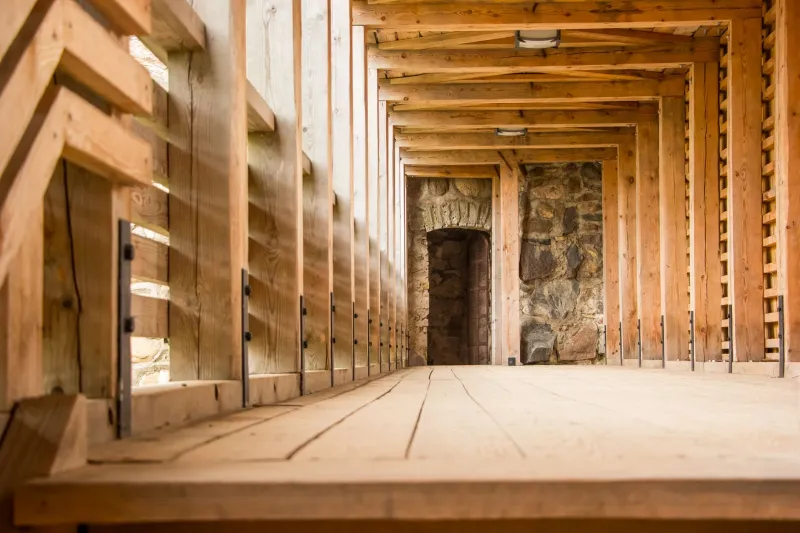
We spend a lot of time thinking about the things hotels control: the thread count, the breakfast menu, the welcome tray. But the most honest ninety seconds of any stay happen before you have opened your door. The corridor is where the brochure stops and the building starts. It is where a hotel tells you, without meaning to, how it is run.
I am not talking about decor. A tired carpet can be charming; a freshly painted corridor can be deeply depressing. I am talking about the small, unmanaged evidence of how a place actually works. Walk slowly. Carry a bag. Pay attention.
Signal one: the floor tells you about the walls
Listen to your feet. A corridor that creaks and booms is not necessarily a badly built one — plenty of old inns have floors that have been settling since the reign of George III — but it does tell you what to expect from the room above. If the boards announce every footstep, you can reasonably predict that you will hear the guests in 12 at 7am, and that they will hear you at 11pm.
What it predicts: acoustics. Not soundproofing, which is a different and more expensive promise, but the general honesty of the building. Hotels that know their floors are noisy tend to provide earplugs, a rug, or a note. Hotels that have never walked their own corridor tend to provide none of the above.
Signal two: the housekeeping trolley
A trolley parked mid-corridor at 4pm is not a scandal. A trolley parked mid-corridor with a linen bag spilling across the fire door is a small editorial comment on staffing. You are looking for whether the corridor is treated as a workspace or a dumping ground. Is there a tidy alcove? Are the bags zipped? Has anyone thought about the guest trying to squeeze past with a suitcase?
What it predicts: the rhythm of the housekeeping team. A hotel that manages its corridors mid-shift is usually a hotel where the room will be properly turned, because someone has thought about the whole route, not just the room itself. It is also a decent clue about how the place handles the 4pm check-in rush.
Signal three: the lighting
Corridor lighting is the most quietly revealing thing in the building. Too bright and institutional, and you feel like you are being processed. Too dim and you are fumbling for a key like a burglar. The tell is the switch. Is there one by the door, or must you walk to the end of the hall in the dark? Are the bulbs warm or grimly white? Has anyone replaced the one that has been out since March?
What it predicts: attention. Lighting is a fiddly, unglamorous thing to get right, and hotels that get it right tend to get the fiddly, unglamorous things right elsewhere — the shower pressure, the tray, the spare loo roll.
Signal four: the smell
The corridor is where a hotel's kitchen, its cleaning products and its history meet. Last night's dinner lingering at 10am is one thing; a smell of damp that has been allowed to settle in is another. Notice whether the air is fresh because a window is open or fresh because someone has sprayed something over a problem. Notice whether the polish smells of polish or of panic.
What it predicts: maintenance. Corridors are the first place where a building's weaknesses show up, because they are the least decorated space in the hotel. A faint whiff of drains near the stairwell is rarely just a corridor issue.
Signal five: the bag problem
This is the simplest test and the one most hotels fail. You are carrying a bag. Is there a lift, and is it where you expected it to be? Are there stairs, and are they lit, and is there a handrail? Does the door open towards you or away from you? Is there anywhere to put the bag down while you find the key?
What it predicts: empathy. A hotel that has thought about the guest with a bag has thought about the guest with a sprained ankle, the guest with a toddler, the guest arriving in the rain. It is a proxy for everything else.
Where the walk is part of the pleasure
None of this is an argument for corridors as a design statement. It is an argument for corridors that feel considered. A handful of independent UK hotels manage it.
At the Beckford Arms in Wiltshire, the walk from the bar to the rooms takes you past creaking boards, low beams and a staircase that asks you to slow down. It is not a corridor in the corporate sense; it is a route through a building that has been a pub for a very long time. The Felin Fach Griffin near Brecon is similar — a short, warm walk with the smell of the kitchen following you up the stairs in the best possible way.
The Angel at Hetton in the Yorkshire Dales has corridors that feel like part of the architecture rather than something added later, and Monachyle Mhor in Perthshire asks you to walk through the old farmhouse to reach your room, which is half the point of staying there. The Gurnard's Head in Cornwall is another: the walk is short, a bit crooked, and entirely in keeping with a building that has never pretended to be a chain hotel.
What the walk is really telling you
A corridor cannot save a bad hotel, and a good hotel can survive a dull one. But the ninety seconds between reception and your door are the closest thing to an unguarded opinion you will get. The room is the product; the corridor is the process. If the process looks thought about, the product usually is too.
So next time you check in, resist the urge to hurry. Walk at the speed of someone carrying a bag. Look at the floor, the trolley, the light, the air, and the door. You will learn more about your weekend in that minute and a half than you will from any photograph on the website.