Pencil Arrows and the Right Pub: How a Hotel’s Local Map Does the Talking
There are welcome books that weigh more than a Sunday roast, and then there are hotel maps that look like they have been rescued from a glovebox. The second kind is usually more useful. At a stylish independent UK stay, a marked-up local map is not a souvenir. It is a working document: a record of what staff actually do on their days off, where they send guests when the kitchen is closed, and which path turns into a swamp after rain. Before you have unpacked, it can tell you whether the place is run by people who know the lane names or by people who know the laminate supplier.
The map is a small act of hospitality
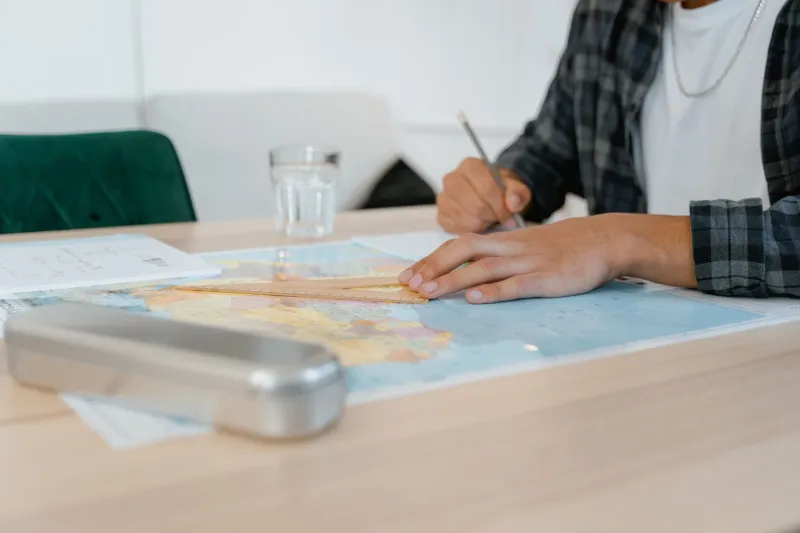
I have a soft spot for the map that is handed over with a biro still warm. Not the glossy leaflet from the tourist board, though those have their place. I mean the photocopied A4 sheet with one corner turned down, a coffee ring near the church, and an arrow pointing to a pub that is not in the guidebook. It says: we live here, we have tested this, and we would rather you had a good afternoon than a mediocre one.
On a recent stay in a converted mill outside Bakewell, the receptionist did not simply point us towards the obvious walk. She took the map, crossed out the suggested route in firm pencil, and wrote: steep and slippery after the bridge, better clockwise. Then she added a pub with food until 2.30pm, a bus back at 4.10pm, and a note about the bookshop in town for a rainy hour. It was more useful than the welcome folder, and it took her ninety seconds.
A small hotel on the Suffolk coast did something similar with tides. The printed map had a lovely dotted line along the estuary. The handwritten version had a time, a height and a warning: do not go past the point after half tide. There was also a note that the fish shack closes on Mondays and Tuesdays, and that the chip shop queue is worth it on a Friday but not on a Saturday. That is not corporate hospitality. That is local knowledge, offered in pencil.
In Northumberland, a riverside place had drawn its own short loop in blue ink. The arrows were wonky, the stile was marked with a tiny sketch, and there was a warning about the boggy bit after the second gate. It also flagged the dog-friendly pub, the bus that stops outside the village hall, and the stretch of road with no phone signal. We followed it. The map was right.
What the annotations actually tell you
A map with no marks is a brochure. A map with marks is a conversation. The crossings out are often the most revealing part. When a hotel scratches out a famous attraction and writes ‘busy, better on a weekday’ or ‘closed for refurbishment until spring’, it is showing judgement. When it circles a farm shop rather than a chain restaurant, it is showing its taste. When it writes down bus times and lunch closing hours, it is showing that it expects you to go out and actually use the place.
Look for specificity. ‘Lovely walk nearby’ is not useful. ‘Twenty minutes to the ford, turn left at the white gate, ignore the footpath sign’ is useful. Tide times, last bus, pub kitchen hours, the shop that shuts at 5pm on Sundays, the path that floods after heavy rain: these are the details that turn a weekend break from a vague wander into a proper day out. They are also the details that staff only know if they live locally or make a point of asking.
Honesty matters too. A good annotated map will tell you what not to do. It will admit that the nearest beach is pebbly, that the hill is steeper than it looks, or that the famous afternoon tea is fine but the bakery two streets back is better. That kind of note is worth more than a wall of framed reviews. It suggests a hotel that would rather you trust it than be impressed by it.
The questions worth asking at check-in
You do not need to launch an interrogation. A simple ask usually works: ‘Have you got a map you actually mark up, rather than the visitor-centre one?’ If the answer is yes, you are in luck. If it is a blank look, try: ‘If we have four hours and it is drizzling, where would you go?’ That question tends to separate the printed script from the lived experience.
Other useful prompts: ‘Which walk would you do with your own dog on a day off?’ ‘What is the one local place you would tell us to skip?’ ‘What time does the last bus back actually go?’ ‘Is there anywhere indoors that is worth the trip if the weather turns?’ On the coast, ask about tides. In the hills, ask about the muddy sections. If you are travelling by train, ask how you get to the good bits without a car. A hotel that can answer those questions without reaching for a folder is a hotel that knows its patch.
If they hand you a map, ask if they mind you taking a photo of their notes. Most are happy to. It also means you can leave the paper behind if you are travelling light, though I usually keep it. A map with someone else’s handwriting on it makes a better souvenir than a fridge magnet.
Green flags and small warnings
Green flags: pencil marks, arrows, dates, bus numbers, tide times, pub lunch hours, a crossed-out tourist trap, a note about a closed path, a recommendation that comes with a reason. A map that has been updated by hand is even better. If someone has written ‘new café here’ or ‘path closed after storms’, you know it is a living document rather than a design exercise.
Warnings: a laminated sheet with no marks at all, a map that only shows the hotel and the car park, or a list of recommendations that reads like a sponsorship deal. That does not make a place bad. Some hotels are new, some are between staff, and some simply have not got round to it. But if you ask for local advice and get a generic shrug, adjust your expectations. You will still have a nice weekend, but you will be doing more of the work yourself.
The best version of this test is not about paper. It is about whether the hotel sees itself as part of the place or as a little island with a nice duvet. A marked-up map is a small sign that the front desk is connected to the village, the coast path, the bus timetable and the pub that does a decent pie. That is the sort of thing that makes a UK weekend break feel less like a booking and more like a recommendation from a friend.
So next time you check in, look at the map before you look at the welcome book. If it has a coffee ring, a pencilled arrow and a note about the best pint in town, you have probably chosen well. If it is pristine, ask for the one they use themselves. A wet December 2026 weekend is exactly the time to find out.